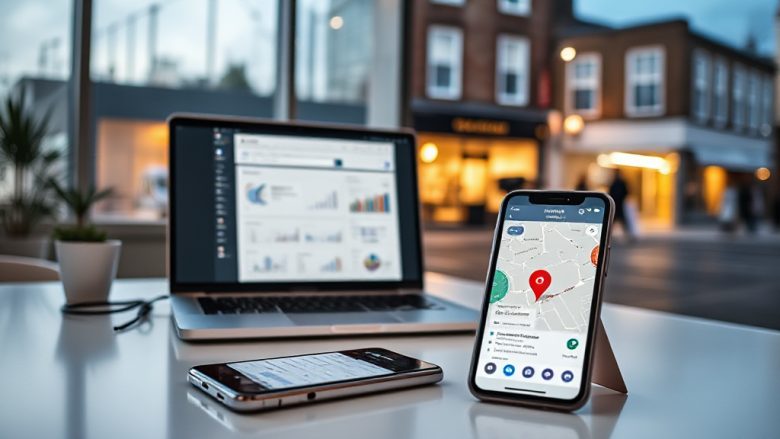
Google Business Profile never sits still. Every few months the dashboard shifts, a feature appears, another gets retired, and the rules for what ranks in the local pack get quietly rewritten. If you run a shop, a clinic, a café or a service business, you already know that your profile is often the first impression a customer gets — sometimes the only one before they decide to call or walk in. The google business profile trends to watch in 2026 point to a platform that is becoming less a static listing and more a live, conversational storefront.
This year the changes aren’t just cosmetic. They touch how customers find you, how they ask questions, how reviews are weighted and how much of your profile you actually control versus how much Google fills in on your behalf. Below are the shifts worth planning for now, with practical notes on what each one means for a small local business.
AI-generated answers are reshaping how people discover local businesses
The biggest undercurrent this year is the move from search results to search answers. More people now type or speak a full question — “who does emergency boiler repair near me on a Sunday” — and get a synthesised answer rather than ten blue links. Google’s AI surfaces pull from Business Profiles, reviews, photos and your website to build that answer. If your profile is thin, inconsistent or outdated, you simply don’t get quoted.
What does that mean in practice? Your profile fields need to read like facts, not marketing copy. Opening hours, service areas, accepted payment methods, accessibility details and the specific services you offer all become raw material for an AI summary. A vague description that says “we do all kinds of work” gives the system nothing to work with. A description that names the three jobs you actually do most weeks gives it something to match against a query.
It also raises the bar on accuracy. An AI answer that misstates your closing time is worse than no answer, because the customer arrives to a locked door and blames you, not the algorithm. Audit your hours, holiday exceptions and service list every quarter. Treat the profile as a data source, because that’s exactly how it’s being read.
Conversational messaging becomes a primary conversion channel
Messaging on Business Profiles has been around for a while, but 2026 is the year it stops being an afterthought. Customers increasingly expect to ask a quick question — “do you have this in a size 42”, “can I bring my dog”, “is there parking” — without phoning. Google has been folding messaging into the same surface where the AI answers appear, so a question asked in search can land directly in your inbox.
The practical implication is staffing. If nobody checks messages, you’ll be marked as unresponsive, and responsiveness feeds into how prominently you appear. Even a short reply within a few hours beats silence. Set expectations in your greeting message: state your typical response time and what you can’t help with. A plumbing firm that says “we reply within two hours during working days; for emergencies please call” saves everyone time.
There’s a second layer here. The questions customers ask in messages are free market research. If five people in a month ask whether you deliver, that’s a signal to add delivery as a listed service and mention it in your description. Your inbox becomes a to-do list for profile improvements.
Reviews get smarter — and harder to game
Review behaviour is shifting in two directions at once. On one side, Google is getting better at detecting fake or incentivised reviews, and penalties now often hit the business rather than the reviewer. On the other, the way reviews are displayed is becoming more nuanced: snippets are pulled for specific queries, and the system weighs recency and specificity more heavily than a wall of five-star ratings with no text.
For local businesses, this changes the playbook. Asking for reviews is still essential, but asking for useful reviews matters more. A customer who writes “fixed our leaking radiator in an hour, quoted upfront, left the place tidy” gives Google something to match against real searches. A row of “great service!” does much less. When you request a review, gently prompt for a detail about what you did — not a script, just a nudge.
Responding matters too, and the tone of your replies is now part of your public profile. A calm, specific response to a critical review often reads better to future customers than the review itself. Don’t argue. Acknowledge, explain what happened if there’s a fair explanation, and say what you’d do differently. That’s the version of your business people trust.
Profiles become richer, more visual and more automated
Google keeps pushing more of the customer experience into the profile itself. Photos, short videos, product listings, service menus, booking links and question-and-answer sections all live there now, and the trend in 2026 is toward profiles that feel almost like lightweight websites. Businesses that upload fresh images regularly tend to get more engagement than those with a handful of photos from years ago.
There’s an automation angle worth watching. Google increasingly auto-populates fields from your website and other sources, then asks you to confirm or correct them. That can be helpful, but it can also introduce errors — a scraped phone number, a service you discontinued, a photo that isn’t yours. Check the “suggested edits” area of your dashboard regularly. It’s easy to miss, and a wrong edit can sit there for months.
Practical steps: add new photos monthly, keep your product or service list current, and use the Q&A section proactively by posting the questions you get most often and answering them yourself. That last habit is underused and quietly effective, because it puts your answer in front of people before they ask.
Local ranking signals broaden beyond the classic three
The old shorthand for local ranking was relevance, distance and prominence. Those still matter, but the mix is widening. Behavioural signals — how often people call, request directions, message or book from your profile — appear to carry more weight than they once did. So does consistency across the web: your name, address and phone number matching everywhere, and your website reflecting the same services your profile lists.
This is where a lot of small businesses quietly lose ground. A profile that says you serve a twenty-mile radius while your website mentions only one town creates a mismatch. A phone number that differs between your profile and your site splits your signals. Fixing these isn’t glamorous, but it’s often the difference between appearing in the map pack and not.
One more shift: proximity matters less than it used to when intent is strong. Someone searching for a very specific service will travel further, and Google seems increasingly willing to show them a well-matched business a few miles away over a poorly matched one next door. That’s good news for specialists. If you do one thing exceptionally well, make sure your profile says so plainly.
What to do in the next ninety days
You don’t need to overhaul everything at once. Start with the foundations: claim and verify your profile if you haven’t, correct every field, and make your description specific rather than promotional. Then build the habits that compound — reply to messages, ask for detailed reviews, respond to them, and upload photos monthly.
After that, watch the dashboard for suggested edits and new feature rollouts. Google tends to release local features gradually, so what you see today may expand in a few weeks. Reviewing your profile once a month, for fifteen minutes, keeps you ahead of most competitors who set it up years ago and never looked again.
The businesses that do well with these google business profile trends to watch in 2026 won’t be the ones with the biggest budgets. They’ll be the ones treating their profile as a living asset — accurate, responsive, specific and current. That’s a manageable discipline, and it pays off in the places that matter: calls, directions and bookings.
Frequently asked questions
How often should I update my Google Business Profile?
Check it monthly and update the important fields — hours, services, photos — as things change. Holiday hours and seasonal closures should be updated at least a week in advance so customers aren’t caught out.
Do AI-generated answers in search actually use my Business Profile?
Yes. AI summaries draw on profile data, reviews, photos and your website. The more accurate and specific your profile, the more likely you are to be included in an answer for a relevant local query.
Is it worth replying to every review, including negative ones?
It’s worth replying to most of them. Responses show you’re active and give you a chance to correct the record calmly. A measured reply to a bad review often reassures future customers more than the review worries them.
What’s the most common mistake local businesses make with their profile?
Setting it up once and leaving it. Stale hours, old photos and unanswered messages quietly cost visibility. A short monthly review fixes most of it.